
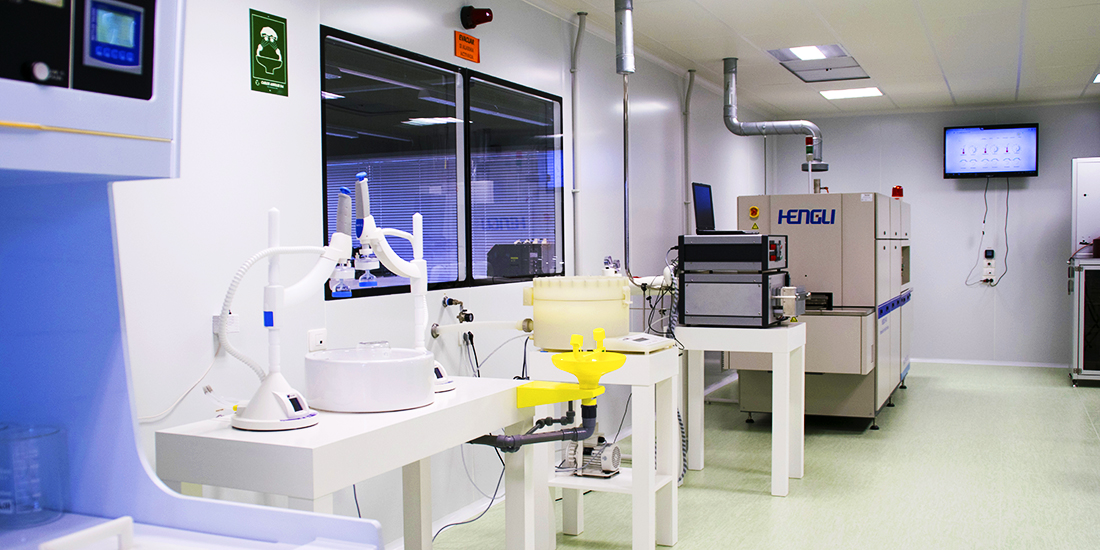
Photovoltaic laboratory – LabCelFV
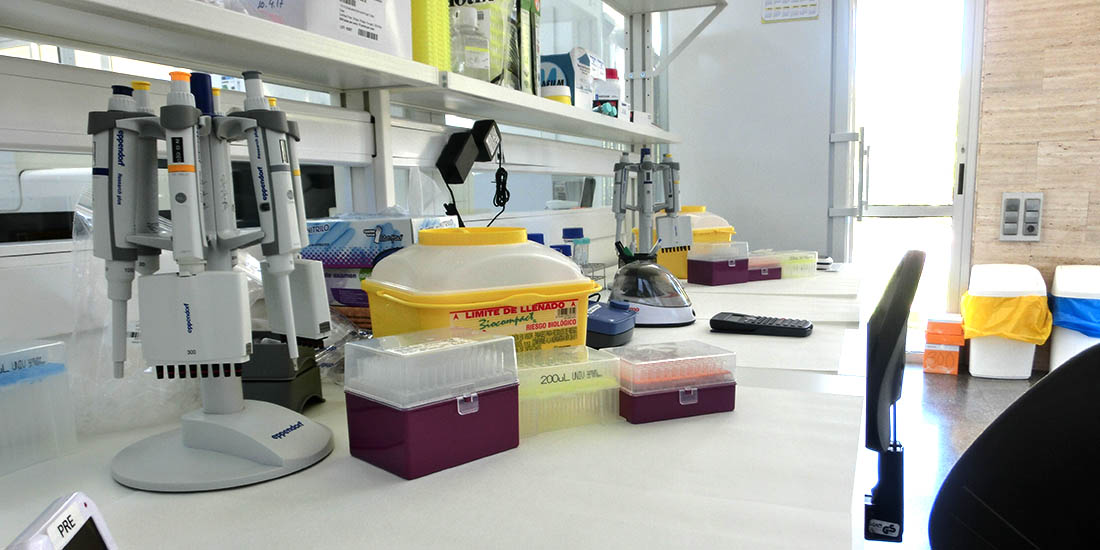
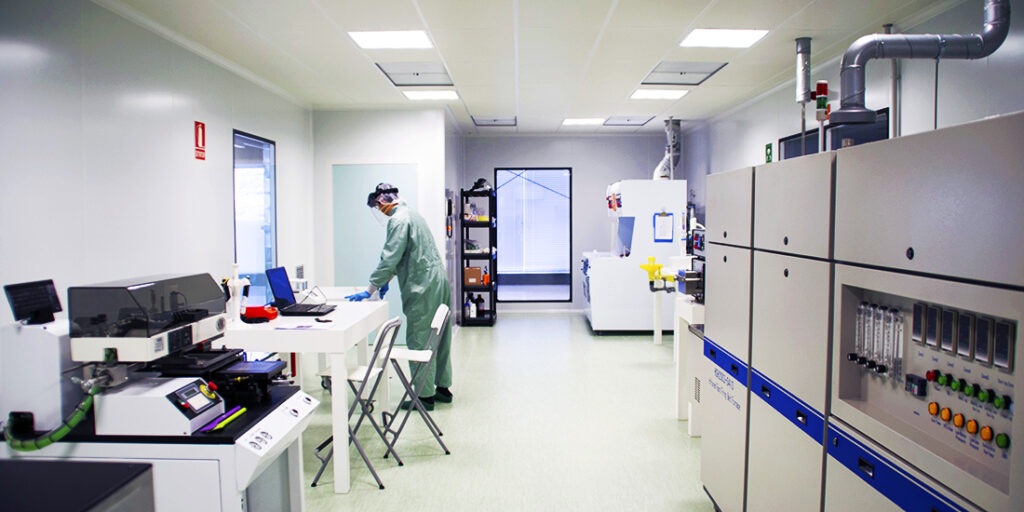
The ITER Photovoltaic Laboratory, known as LabCelFV, is a cutting-edge scientific and technological facility designed to contribute to the development and strengthening of new manufacturing techniques for crystalline silicon photovoltaic cells and new materials. Its dimensions and modular nature give it flexibility and adaptability to new processes, such as research with new materials for use in photovoltaic technologies.
The main research lines have been developed in the field of photovoltaic cells based on crystalline silicon.
In addition, a new research line has been initiated focusing on the study of emerging materials, specifically those that, due to their crystalline structure, are classified as perovskites.
In order to evaluate and analyze each phase of the manufacturing process, the laboratory is conceived as a scaled system of an industrial production line, where the fabrication and characterization processes of the devices are carried out.
The infrastructure includes two work areas: one dedicated to the fabrication of photovoltaic cells (ISO 7 Cleanroom) and another dedicated to their characterization.
This laboratory has been optimized within the framework of the MACLAB-PV project, “Enhancement of R&D&I capacities and infrastructures in the renewable energy and energy efficiency sector in the Canary Islands and Senegal,” co-financed by the INTERREG MAC 2014–2020 Programme.
Laboratory equipment:
Manufacturing Laboratory – Clean room
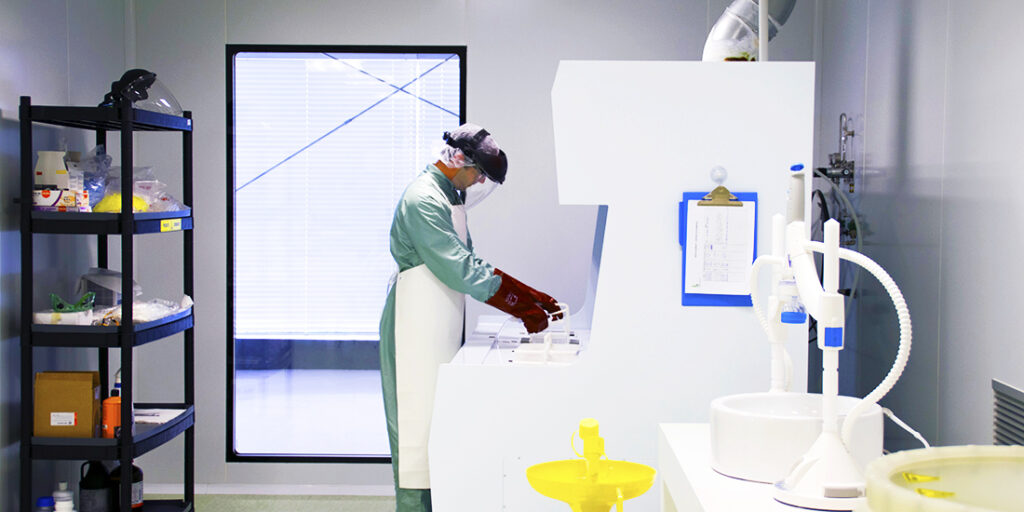
The ISO 7 clean room (class 10,000) has a total surface area of 65m² and is equipped with the following:
- System for cleaning and texturing substrates. Chemical bench – Achiever, MEI.
- Ultrasonic bath. ULTRASONS-HD, JP Selecta.
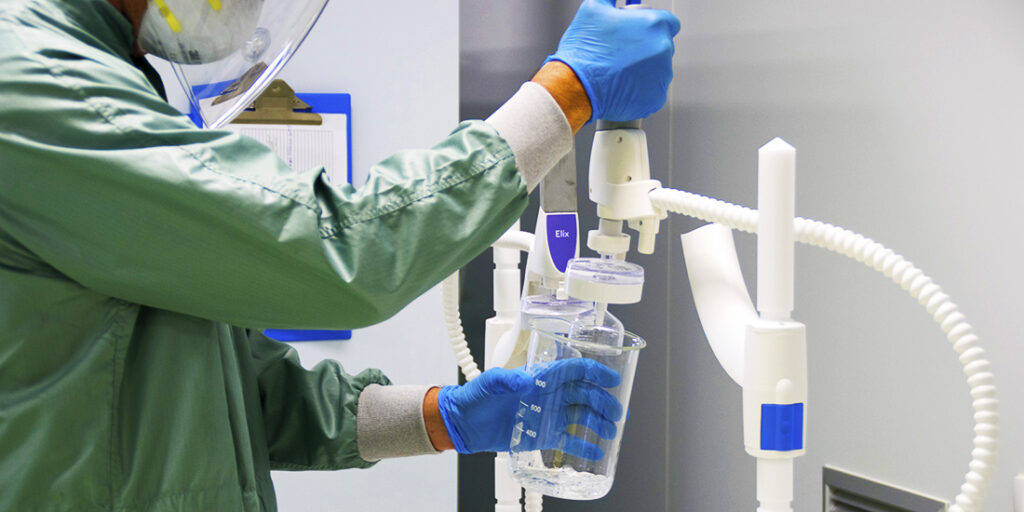
- Production and supply of type II pure water (E-POD) and type I ultra-pure water (Q-POD). Milli Q-Integral 3, Millipore.
- Spin-On deposition system. Polos HD 300, SPS.
- Rapid thermal process diffusion furnace. TM 100BT, LPT THERMPROZESS.
- Firing chain kiln. Hengli, Torrey Hills Technologies, LLC.
- Muffle furnace. CWF 11/13, Carbolite.
- Drying oven. Conterm 19, JP Selecta.
- Open chamber PECVD system for chemical vapour deposition. Vision 300 MK II, Advanced Vacuum.
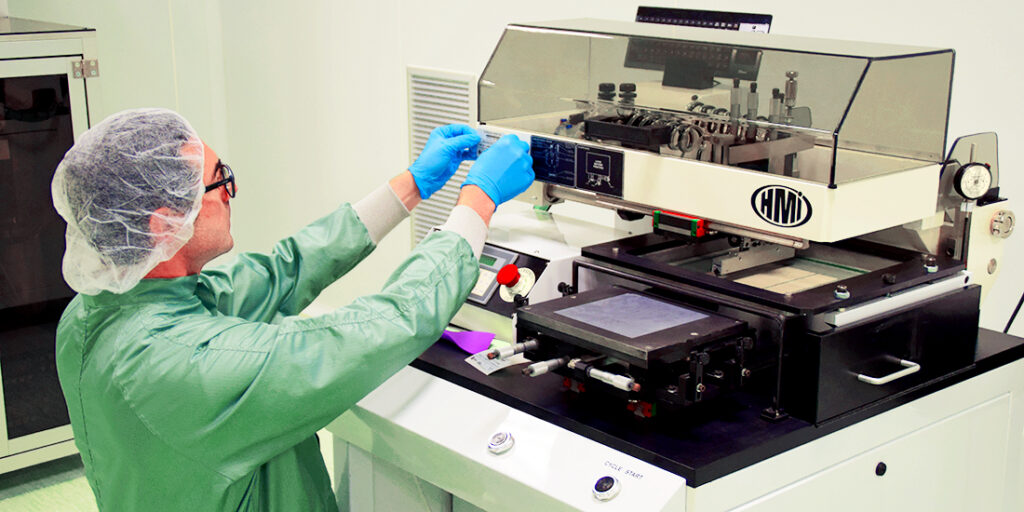
- Screen printing system for printing metal contacts. 485 – Screen Printer, HMI.
- Three-roll mill. ESG65, Shanghai Espread.
Characterisation Laboratory
The characterisation laboratory has a total area of 110m2 and is equipped with the following:
- Spectral Response System. PVE 300, Bentham.
- Optical Fluorometer System. FLUOROSENS M11, Gilden Photonics.
- Ellipsometer. ESM-300, J.A. Woollam.
- Microwave photocurrent decay measurement equipment (MWPCD). WT-2000PVN, Semilab.
- Semiconductor characterisation system. SCS-4200, Keithley
- Pulsed laser kit with 2D processing scanner and opto-mechanical components. Powerlase
Auxiliary equipment
- Air conditioning and filtration system..
- Particle counting system.
- Closed-loop water system with chiller.
- Deionised water recirculation system.
- Corrosive liquid evacuation system.
- Compressed air distribution line.
- Distribution line for a mixture of 2% silane and nitrogen (gas cabinet).
- Distribution line for a mixture of 20% oxygen and tetrafluoromethane gas.
- Distribution line for 99.9980% nitrogen gas (technical).
- Distribution line for 99.9995% nitrogen gas (ultra-pure).
- Nitrous oxide gas distribution line.
- Ammonia gas distribution line.
- Toxic gas abatement system.
- High-temperature gas extraction system.
- Toxic gas extraction system.
Virtual tour of the photovoltaic laboratory – SiCell Lab
Discover this scientific and technical infrastructure at ITER thanks to this virtual educational tool developed as part of the MACLAB-PV project, ‘Improving R&D&I capabilities and infrastructure in the renewable energy and energy efficiency sector in the Canary Islands and Senegal’, co-financed by the INTERREG MAC 2014-2020 Programme.
Related links: